
electric motorcycles
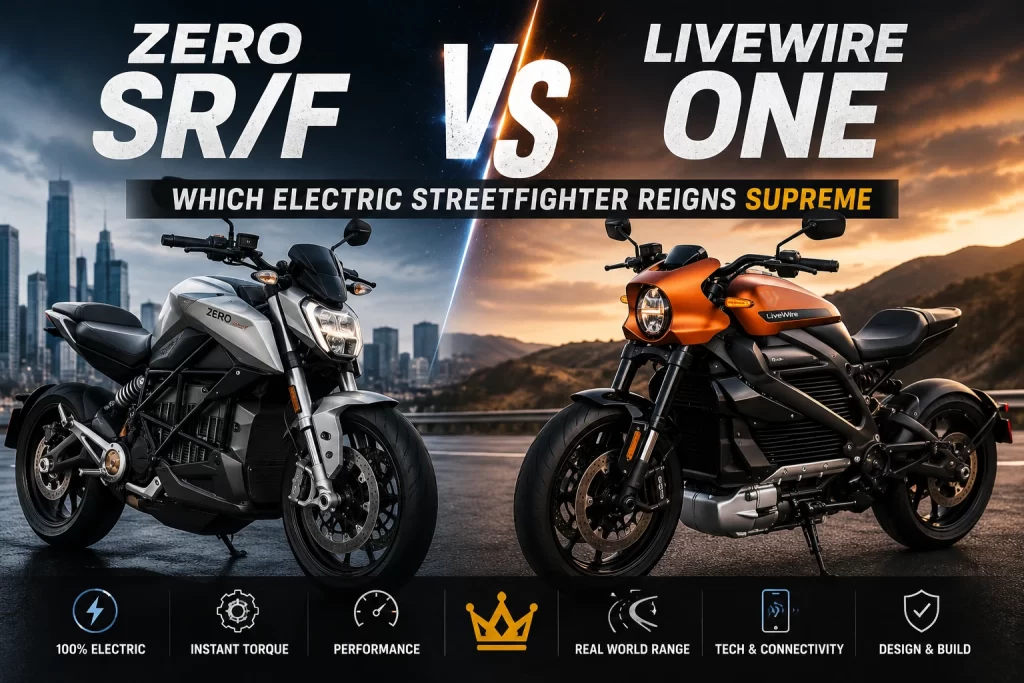
Zero SR/F vs LiveWire One: Which Electric Streetfighter Reigns Supreme
Apr
There was a time when “electric motorcycle” was a punchline at biker meetups — a polite way of saying underpowered scooter with delusions of grandeur. That time is over. Today, two bikes sit at the top of the naked-EV mountain, both pulling close to triple-digit horsepower, both wearing aggressive streetfighter clothes, both asking serious money. The Zero SR/F, built by California’s all-electric pioneer Zero Motorcycles. And the LiveWire One, the offspring of Harley-Davidson’s bet that the future doesn’t sound like a V-twin.
So which one actually deserves the keys to your garage? Let’s get into it.
The Contenders at a Glance
The Zero SR/F has been Zero’s halo naked since its 2019 debut, and the current version still wears its mission on its sleeve. The model name literally stands for StReetFighter. It packs a 17.3 kWh battery, a Z-Force 75-10 motor making 111 hp and 140 lb-ft of torque, and a top speed of 124 mph. MSRP starts around $21,995.
The LiveWire One is the bike Harley spun out into its own brand in 2021. It’s powered by the H-D-engineered Revelation powertrain, makes 100 hp and 86 lb-ft of torque from a 15.4 kWh battery, and rips from 0 to 60 mph in just three seconds. MSRP sits at $22,799.
On paper, the Zero looks like the bigger hammer. In practice, the answer is more interesting than that.
Design & Soul
The SR/F looks like what an industrial designer draws when you say “electric streetfighter.” Stacked LED headlight, opalescent light pipes flanking it, stubby tail, exposed orange battery casing. It’s clean, modern, and unapologetically futuristic. Nothing about it pretends to be a gas bike.
The LiveWire One takes a different swing. The frame is muscular, the lines are aggressive in a more familiar way, and Harley’s industrial design fingerprints are all over the cast aluminum chassis and the way the bike wears its bulk. It looks like a motorcycle first and an EV second — and for a lot of riders coming from gas, that matters.
Personal taste decides this round. The Zero feels like it came from 2030. The LiveWire feels like it came from a Milwaukee design studio that finally got electrified.
Powertrain & Performance
Here’s where the on-paper story gets flipped on its head.
The Zero punches harder by the numbers — 111 hp and a thumping 140 lb-ft of torque, with a 124 mph top speed. The LiveWire tops out lower (manufacturer specs around 110 mph) and brings less peak torque to the fight.
But the LiveWire is faster off the line. It hits 60 mph in three seconds flat, and it’ll go from 60 to 80 in another 1.9 seconds. Cycle World clocked the SR/F at around 3.7 seconds to 60. Why? The Revelation motor delivers its power in a way that feels more linear and more connected — there’s a haptic pulse at idle that gives you a heartbeat through the seat, and the motor’s high-pitched turbine whine at speed is genuinely thrilling. The Zero is silent and seamless and almost eerie in its delivery. Both are fun. They’re just different kinds of fun.
If you want top-end speed and the biggest torque number, the Zero wins. If you want the most visceral, get-you-grinning launch experience, the LiveWire takes it.
Range & Charging — The Real Battlefield
This is where electric streetfighters actually win or lose, and the two bikes split sharply.
Zero SR/F:
- 117 miles combined city/highway range
- 6.6 kW integrated Level 2 charger
- ~1 hour to 95% on a Level 2 station
- No DC fast charging on the standard model (Cypher upgrade required)
LiveWire One:
- 146 miles city / 95 highway combined range
- DC Fast Charging (Level 3) standard
- 0 to 80% in 40 minutes, 0 to 100% in 60 minutes on a Level 3 charger
The Zero wins charging at home overnight; both will be ready by morning. The LiveWire wins everywhere else. If you’re road-tripping, stopping at a DC fast charger on the highway, or just hate planning your day around a battery, the LiveWire’s Level 3 capability is a huge practical advantage. Zero will sell you a fast-charge upgrade, but it’s an extra cost and not standard equipment.
Real-world tests have also consistently shown the LiveWire is more energy-efficient under spirited riding. Cycle World’s earlier head-to-head found the LiveWire roughly 10% more efficient, with usable range left in the tank when the Zero was already dry.
Range round: LiveWire One.
Chassis, Brakes & Handling
Both bikes use Showa suspension that’s fully adjustable at both ends — high-end stuff. The Zero runs a 43mm BP-SFF fork and a Showa piggyback rear shock. The LiveWire uses Showa’s SFF-BP fork and BFRC rear shock. Quality is comparable.
Brakes are where it tilts. The LiveWire One runs Brembo front calipers with the kind of initial bite you expect from premium Italian hardware. The SR/F runs J.Juan dual four-piston calipers on 320mm discs — strong, but not quite Brembo-strong. Riders who’ve ridden both consistently report the LiveWire’s brakes feel more authoritative.
On weight: the Zero comes in around 498 lbs, the LiveWire closer to 562 lbs. That’s a real-world ~64 lb advantage to the Zero, and you feel it when you’re flicking through traffic or muscling the bike around a parking lot. The Zero feels lighter and more agile; the LiveWire feels planted and substantial.
Handling is a wash for most riders. Pick the personality you want.
Tech, Rider Aids & Daily-Use Stuff
Both bikes are loaded. Cornering ABS, traction control, multiple ride modes, full-color TFT displays, smartphone connectivity — all standard on both.
The Zero edges out on configurability. Its Cypher III+ operating system offers five ride modes (Rain, Eco, Standard, Sport, Canyon), a 5.0″ TFT (vs. the LiveWire’s 4.3″), stability control, and over-the-air firmware updates that genuinely add features over time. Heated grips are standard.
The LiveWire counters with custom ride modes you can tune in 1% increments — Available Power, Throttle response, and Regenerative Braking are all dial-in adjustable. That’s an enthusiast-grade level of control that the Zero’s preset modes don’t quite match. Plus the haptic heartbeat. Sounds gimmicky on paper. Feels great in practice.
Tech round: roughly even, with the Zero ahead on raw feature count and the LiveWire ahead on tunability and refinement.
Price & Value
The Zero SR/F starts around $21,995. The LiveWire One starts at $22,799. About $800 separates them, which is essentially nothing in this segment. Anyone telling you the LiveWire is dramatically more expensive is reading old spec sheets — that gap has all but closed.
What you’re really paying for differs. The Zero gives you more bike on paper for slightly less money. The LiveWire gives you Brembos, DC fast charging, and Harley-Davidson’s dealer and service network for a small premium.
The Verdict
Calling a winner here depends entirely on how you ride.
Buy the Zero SR/F if: you want the highest top speed, the most torque, the lighter and more agile chassis, the bigger feature list, and a bike that feels like it was designed from a clean sheet for the electric era. You charge at home, your rides are loops back to your driveway, and you want maximum spec for your dollar.
Buy the LiveWire One if: you want DC fast charging (and the freedom that comes with it), more usable range under spirited riding, Brembo brakes, the more visceral and emotional riding experience, and the comfort of a global Harley dealer network behind you. You ride farther, you stop at chargers in the wild, and you want a bike that feels like a real motorcycle that happens to be electric.
If you put a gun to my head and asked which one reigns supreme in 2026, I’d give the crown to the LiveWire One — but barely, and only because charging infrastructure is the make-or-break factor for living with an electric motorcycle today, and the LiveWire is the only one of these two that takes Level 3 seriously out of the box. The Zero is the better spec sheet. The LiveWire is the better real-world ownership experience.
But honestly? Test ride both. The streetfighter that sparks more joy under your right wrist is the one that wins. And the fact that we now have two serious answers to that question — that’s the real story.

Hi, this is a comment.
To get started with moderating, editing, and deleting comments, please visit the Comments screen in the dashboard.
Commenter avatars come from Gravatar.